Investors are always looking for an edge. If you already embrace the philosophy of owning the broad market through diversification, that edge has to come from somewhere other than picking stocks or timing the market. Taxes are one area where investors have more control. Asset location, the practice of placing investments in different accounts based on their tax costs, is one way to attempt to gain a tax edge. That being said, it can be complex to manage, and its payoff depends on the accuracy of our assumptions about future investment returns, the tax character of those returns, and future tax rates, all of which we can't predict with confidence. In this article, we'll explore why asset location may not be worth the extra effort.
What Is Asset Location
Asset location is the practice of placing various investments in different account types in order to reduce taxes and improve after-tax returns. This is different from asset allocation, which decides how much of your portfolio is in stocks versus bonds.
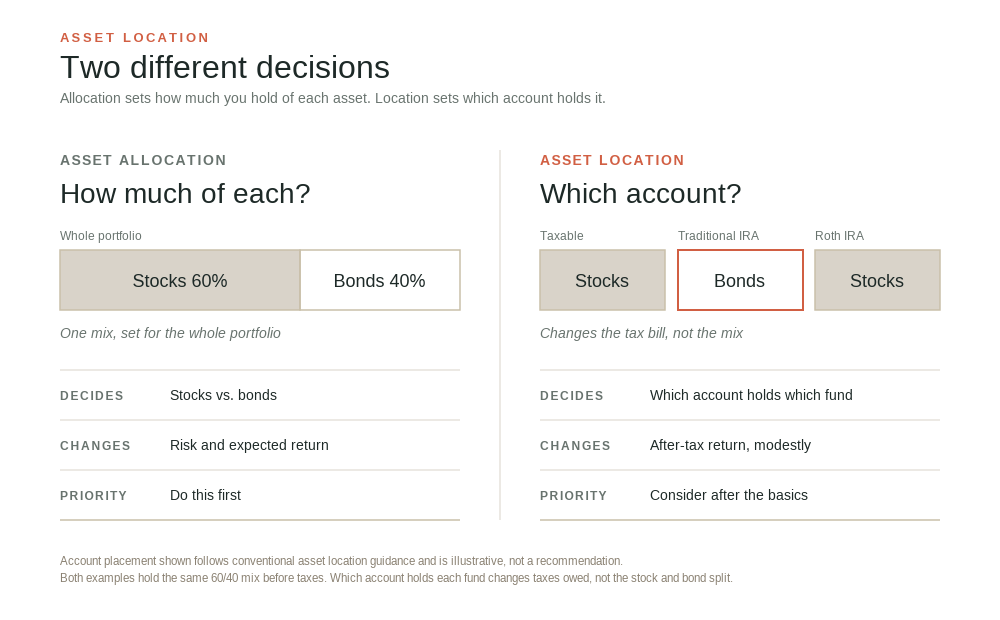
Imagine you have a taxable brokerage account and a Traditional IRA. You've decided your asset allocation, based on your ability and willingness to take risk, will be 60/40: 60% in stocks and 40% in bonds. In the brokerage account, dividends, interest, and realized gains are taxed each year. In the Traditional IRA, nothing is taxed until you withdraw the money, and then it's taxed as ordinary income.
Bonds typically pay a higher yield than stocks, and that interest is generally taxed at ordinary income rates. Stocks generally pay lower dividends, which are often qualified and taxed at a preferential rate of 0%, 15%, or 20%, and their growth isn't taxed until you sell. Using asset location, you might place your bonds inside the Traditional IRA and your stocks inside the brokerage account.
The Conventional Wisdom
Most asset location advice follows a handful of rules.
- Hold bonds in tax-deferred accounts. Interest from taxable bonds is taxed at ordinary income rates. Inside a tax-deferred account like a Traditional IRA, 401(k), or 403(b), that income isn't taxed until you withdraw it.
- Hold stocks in taxable accounts. Stocks and stock index funds tend to produce little taxable income compared with many bonds and bond funds. Qualified dividends and long-term capital gains also receive more favorable rates than ordinary income. This makes stocks tax efficient.
- Consider holding international stocks in taxable accounts. Many international funds pay foreign taxes on dividends. In a taxable account, investors may be able to claim a foreign tax credit for qualifying taxes passed through by the fund. That credit isn't available inside an IRA or 401(k).
- Favor higher-growth investments in Roth accounts. Qualified Roth withdrawals are tax-free, so placing the investments with the highest expected returns here can be beneficial.
In a 2004 paper, Robert Dammon, Chester Spatt, and Harold Zhang modeled how an investor with both taxable and tax-deferred accounts should allocate and locate assets over a lifetime. They found a strong preference for holding taxable bonds in the tax-deferred account and equity in the taxable account, because taxable bonds carry a higher tax burden than equity. For most investors, that result held up when tax-exempt bonds and liquidity shocks were added to the model.[^1]
In a 2005 discussion hosted by the TIAA-CREF Institute, the same authors and economist James Poterba added several points.[^2]
- Deferring capital gains, and choosing when to realize them, makes equities especially attractive in taxable accounts.
- The longer the investment horizon, the more is at stake in choosing the right location.
- The greater the gap between the tax rates on different investments, the greater the potential benefit.
How Much Can It Add?
The paper by Robert Dammon, Chester Spatt, and Harold Zhang also put a price on ignoring the advice. In the authors' model, holding the same mix in both accounts cost an investor generally less than 5% of wealth, while the worst placement, filling the tax-deferred account with equity first, cost young investors nearly 15%.[^1] Those figures come from a model that taxes dividends and interest at the same 36% rate and assumes a 6% bond yield. Tax law has since made stocks more tax-favored, which the authors said strengthened their recommendation.[^2] Spread over several decades, a 5% difference works out to roughly 0.1% to 0.16% a year.
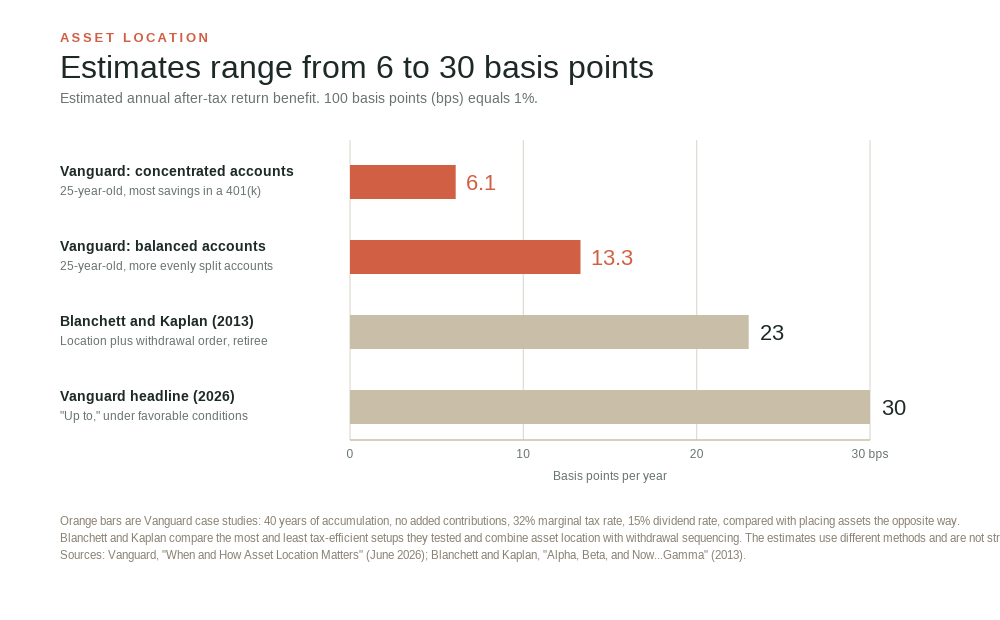
Furthermore, in a 2013 paper, David Blanchett and Paul Kaplan of Morningstar estimated a return-equivalent benefit of about 0.23% a year from combining tax-efficient asset location with smart withdrawal sequencing in retirement.[^3] Return-equivalent means the extra annual return that would improve a retiree's income by the same amount. The estimate covers both strategies together, so it isn't the value of asset location alone. It also compares the most tax-efficient setup the authors tested with the least efficient one, which the authors acknowledge is a comparison of the best outcome with the worst.
More recently, Vanguard revisited the topic in its June 2026 research note, When and How Asset Location Matters. It estimated that asset location could improve annual after-tax returns by up to about 0.30% for certain investors.[^4] Separate Vanguard research on equity asset location suggested that placing different equity subclasses thoughtfully could add up to another 0.10% a year under favorable circumstances.[^5]
These numbers sound great, but not every investor is able to structure their portfolio to achieve them. To obtain these tax location benefits, Vanguard identifies three favorable factors:
- A balanced allocation between stocks and bonds
- Meaningful balances in both taxable and tax-advantaged accounts
- Enough time for the tax savings to compound
A retiree in their 70s with 75% of their wealth in a Traditional IRA has little taxable-account room to work with, so the benefit is likely to be smaller. The same goes for an investor who holds far more of one asset class than the other, such as an 80/20 or 20/80 portfolio.
Vanguard's case studies show how much these factors matter. A hypothetical 25-year-old with most savings in a 401(k) gained just 6.1 basis points a year (0.061%) from asset location, compared with placing assets the opposite way. A more balanced investor, with more evenly spread account balances, gained 13.3 basis points a year (0.133%). Both simulations assumed 40 years of accumulation, no additional contributions, a 32% marginal tax rate, and a 15% dividend tax rate. Both are far below the 0.30% headline.
A $10,000 initial investment, contributing $500 a month for 40 years at a 9% annual return works out to be $2,341,388.87. A 9.061% return (the benefit of asset location for this 25-year-old) yields a final balance of $2,381,919.34. This is a dollar difference of about $40,000, or $1,000 per year.
The Benefit Depends on Things You Can't Know
Vanguard simulates thousands of possible return paths, but the paths are drawn from assumptions about expected returns, and the tax rules are held fixed. Real investors don't get a fixed tax code or a known distribution of returns. We don't know:
- Future tax rates. The benefit depends on the gap between the rate you pay on bond interest and the rate you pay on stock income. Both depend on your future income, your bracket, and rules Congress can and has changed.
- Future returns. If stocks and bonds earn different amounts than assumed, the tax drag on each changes. When bond yields are low, there is less taxable interest to shelter, and the benefit shrinks. The form of the returns matters too. If a fund pays a large capital gain distribution, the benefit of asset location can be reduced.
- Time horizon. Most of the gain comes from compounding over many years. An investor with a shorter time frame will benefit less.
- Account mix. The estimates assume meaningful balances in both taxable and tax-advantaged accounts.
- Withdrawal order. Which accounts you spend first changes how much tax the strategy saves.
You Might Be Taking More Risk
An important, and often overlooked, impact of asset location is that two portfolios with the same pre-tax allocation can carry different after-tax risk.
A Traditional IRA balance isn't worth its full face value to the investor, because part of it will eventually be owed in income taxes. Roth dollars have already been taxed, and qualified withdrawals are tax-free. That difference changes an investor's actual exposure to stocks and bonds.
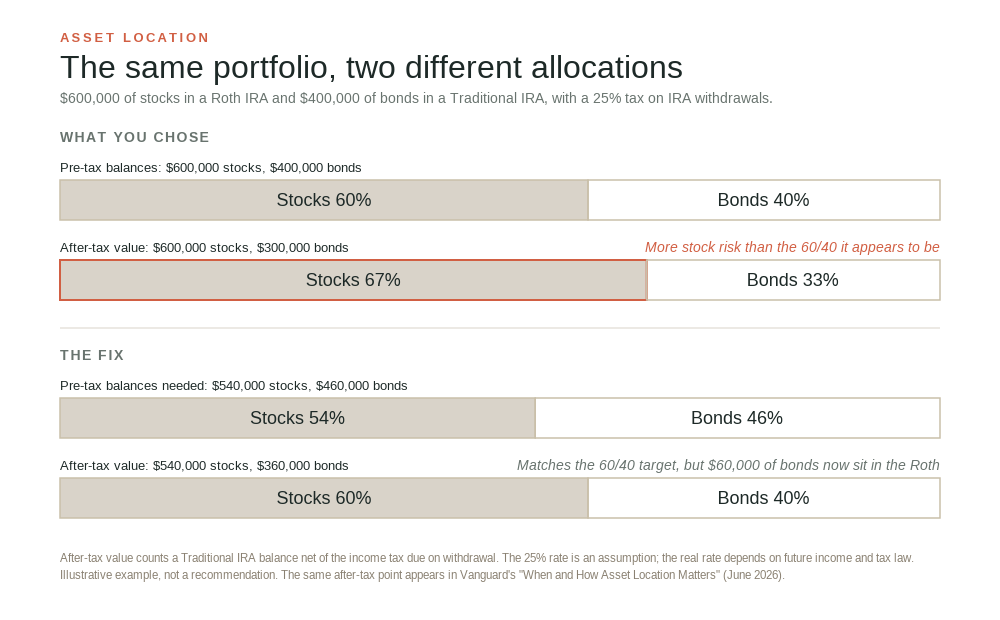
Take an investor with $600,000 in a Roth IRA and $400,000 in a Traditional IRA. Following the conventional rules, they hold all of their stocks in the Roth, since higher-growth assets belong in tax-free accounts, and all of their bonds in the Traditional IRA. On paper, that is a 60/40 portfolio. Assume future withdrawals from the IRA will be taxed at 25%.
| Pre-tax balance | After-tax value | |
|---|---|---|
| Stocks (Roth IRA) | $600,000 | $600,000 |
| Bonds (Traditional IRA) | $400,000 | $300,000 |
| Allocation | 60% / 40% | about 67% / 33% |
After accounting for future taxes, the allocation is closer to 67/33, which is more aggressive than the 60/40 it appears to be. Stocks make up about two-thirds of what this investor can actually spend, not 60%. Vanguard's 2026 note makes the same point with its own example: at a 32% tax bracket, an 80/20 portfolio built this way becomes about 85.5/14.5 after taxes.[^4]
This also changes how asset location results should be read. Moving stocks toward Roth accounts and bonds toward Traditional accounts can raise a portfolio's expected return, because the after-tax portfolio is more aggressive. A model that tracks only pre-tax balances will credit that gain to tax efficiency, but some of it is simply the reward for holding more stock risk. The investor could have earned the same reward by raising their stock allocation, with no change in where anything sits. Researchers separate the two: "tax alpha," the improvement from tax efficiency, and changes in after-tax risk exposure, or "beta."[^4] A fair comparison holds the after-tax allocation constant.
Holding it constant has a cost. To keep a true 60/40 after taxes, this investor would need about $540,000 of stocks and $360,000 of after-tax bonds. That means holding roughly $60,000 of bonds in the Roth, for a pre-tax mix of about 54/46. The adjustment partly undoes the account placement that made the strategy look attractive.
The Cost of Complexity
Let's say so far everything is right for you. You have a large portfolio split 50/50 between stocks and bonds and across a Roth IRA and Traditional IRA. We still need to factor in the costs of complexity.
One of the best features of a simple portfolio is that the same allocation can be held in every account. If the target is 60% stocks and 40% bonds, that mix can sit in an IRA, a 401(k), and a brokerage account. Each account can be managed on its own, and new contributions follow the same plan.
Asset location makes that harder.
- Rebalancing. The desired allocation has to be maintained across accounts, not within each one. If stocks outperform, restoring the target may require trades in several accounts, and small balances can limit what is possible.
- New contributions. Adding money to a 401(k) may require adjustments elsewhere to keep the overall mix intact.
- Withdrawals. A retiree who holds nearly all their stocks in a taxable account may have to realize large capital gains to cover an unexpected expense.
- Tax law changes. An arrangement optimized around today's brackets, dividend rates, and capital gains rules may not stay optimal over an investor's lifetime.
- Transition costs. Selling appreciated investments in a taxable account to reach a better location can trigger an immediate tax bill that outweighs years of expected savings.
These costs are hard to justify when the benefit may be only a few basis points.
Vanguard makes this tradeoff explicit in its 2026 research. It warns that deviating from rebalancing targets is far more damaging than imperfect asset location, and it recommends investing the next dollar in tax-advantaged accounts first, subject to liquidity needs and time horizon. Asset location comes after both.[^4]
There is a behavioral cost too. Investors can get so focused on building the perfect portfolio that they delay investing at all. Avoiding unnecessary taxes is worthwhile, but saving a few basis points shouldn't become a reason to leave money uninvested.
If an advisor handles this for you, ask whether they charge extra for it. The added fee may be larger than the tax savings asset location has to offer.
When It May Be Worth It
One of the clearest cases for asset location is phantom income. Some investments create a tax bill before you receive any cash. Treasury Inflation-Protected Securities (TIPS) are one example: their principal rises with inflation, and that increase is taxed each year even though you don't receive it until maturity. Zero-coupon bonds create a similar problem, because interest accrues annually without being paid. Held in a Traditional IRA or 401(k), the tax is deferred until withdrawal. Held in a taxable account, you owe tax with no cash from the investment to pay it.
Asset location also works better when:
- You are in a high tax bracket
- You have meaningful balances in both taxable and tax-advantaged accounts
- You can make changes through new contributions or rebalancing inside retirement accounts, without realizing large taxable gains
- Your time horizon is long
What Should I Do?
Asset location should be approached with caution. The expected improvement is often modest. It depends heavily on assumptions about future returns and taxes, and it adds portfolio-management complexity. Some apparent gains also reflect a change in after-tax risk exposure, not a real increase in tax efficiency.
For most investors, a sensible default is to hold the same diversified allocation in every account unless there is a clear reason not to.
That doesn't mean ignoring taxes. Choosing an appropriate allocation, keeping costs low, and investing consistently in tax-advantaged accounts matter more, and asset location can come after those are in place.
A portfolio that is simple, diversified, inexpensive, and easy to maintain may serve an investor better than one optimized to capture a small, uncertain tax advantage.