When constructing the fixed-income portion of a portfolio, investors face a choice: purchase individual bonds or invest in a bond fund. At first, this may seem like a straightforward decision. However, differences in cost (both hidden and explicit), liquidity, and the timing of when the money is needed can make this a nuanced one. We'll walk through the key differences between individual bonds and bond funds, and lay out a practical framework for deciding which one, or which combination, makes the most sense for you and your portfolio.
Individual Bonds
When you purchase an individual bond, you are loaning money to the issuer. Issuers can be corporations, governments, or municipalities. The typical bond is purchased at its par value (often $1,000), pays interest semi-annually, and at maturity, returns the par value back to the investor. For example, Apple, Inc. might issue a 5-year bond with a 5% coupon for $1,000, denoted as AAPL 5.000% 09/10/2031. Twice a year you would receive $25 (5% of $1,000, divided by 2). After the 5th year, you would get your $1,000 back.
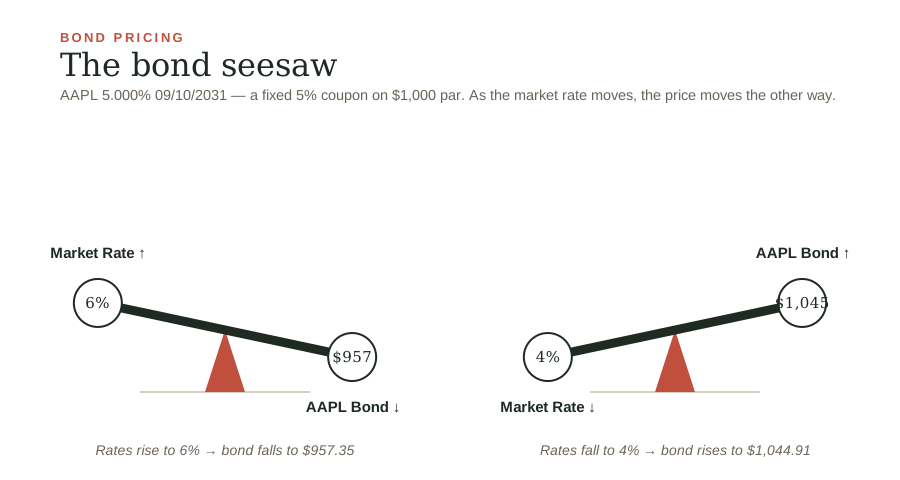
Bonds do not have to be purchased at issuance on the primary market. An investor can, and often does, purchase bonds on the secondary market, where they trade at a premium or a discount. This premium or discount is based on the bond's coupon rate relative to current interest rates. For example, let's use the AAPL bond above. At issuance, it sold for $1,000. If bonds of similar duration and credit are paying 4%, the AAPL bond will trade at a premium (above $1,000) because it pays more than what is currently available in the market. An easy way to think about this: if the Apple bond could still be bought at par, no one would buy the new 4% bond instead. The demand for the Apple bond would push up its price. Your coupon payment would still be 5% of the original par, but the current yield would be closer to 4%. The exact price of the bond would fall somewhere near $1,045.
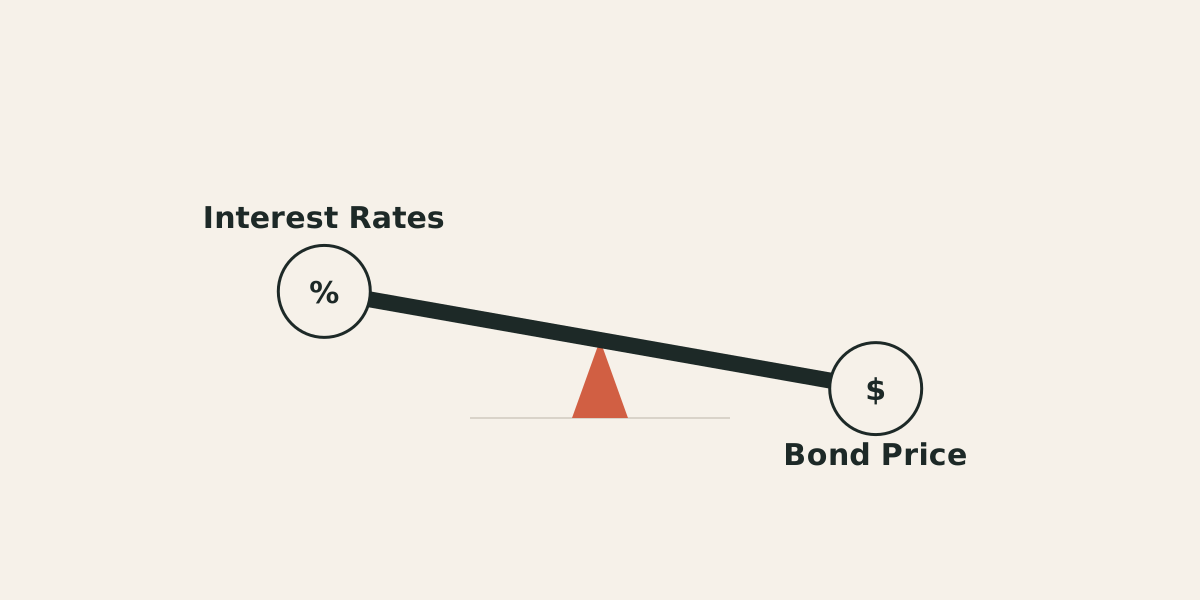
Conversely, if current interest rates are 6%, that same bond will trade at a discount (below $1,000) because it pays less than what is currently available in the market. Investors will not pay $1,000 for a bond that pays 5% when they can buy a new bond for $1,000 that pays 6%. The price of the bond would fall somewhere near $957. This is called the bond seesaw: when interest rates rise, bond prices fall, and when interest rates fall, bond prices rise.
Bond Funds
Bond funds are baskets of bonds, managed by a fund manager. These funds can be mutual funds or ETFs, and either actively or passively managed. Owning a bond fund means owning a diversified basket of bonds, rather than a single issuer.
Bond funds typically have no set end maturity. Revisiting our AAPL bond example, a bond fund targeting a 5-year duration might hold that same Apple bond alongside dozens of other 5-year corporate bonds, spreading exposure across many issuers rather than concentrating it in one. As the AAPL bond gets too close to maturity, the fund sells it and purchases a new 5-year bond to maintain that target duration, repeating this process continuously across its entire portfolio.
Individual Bonds: Advantages and Disadvantages
Individual bonds are unique in that they have a maturity date. If you hold the bond until maturity, regardless of what happens to interest rates, you will receive the par value of the bond, assuming the issuer does not default. Because default risk is a real concern, you'll generally have to purchase bonds with a higher credit rating to manage that risk, which means potentially sacrificing some return.
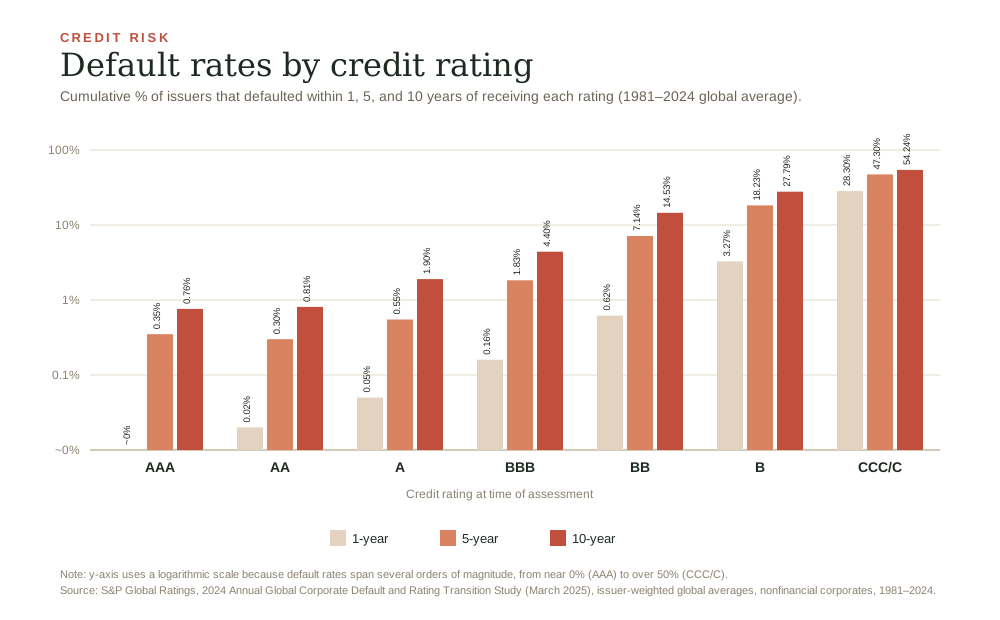
S&P Global Ratings' 2024 Annual Global Corporate Default and Rating Transition Study found that AAA-rated bonds, the highest rating available, have a 0.76% cumulative default rate over 10 years.[^1] BBB-rated bonds, the lowest rating that still counts as investment grade, default at a rate of 4.40% over the same period. That's nearly six times higher, despite still being considered investment grade.
One way to manage default risk is to purchase Treasuries instead of corporate bonds. Treasuries are widely considered risk-free, since they're backed by the full faith and credit of the U.S. government. That safety has historically come at a slight cost. Using Morningstar's Ibbotson SBBI dataset going back to 1926, long-term U.S. government bonds have returned an average of 5.9% annually, compared to 6.3% for long-term corporate bonds over the same period.[^2]
To manage default risk, you'd have to purchase multiple bonds yourself, which costs time, money, and the ongoing work of managing the portfolio and reinvesting coupons. Or you could buy Treasuries instead, accepting a slightly lower return, but you'd still face many of the same drawbacks that come with holding individual bonds. Even with 20 or 30 individual bonds, a single default can still have a meaningful impact on your return.
One advantage of individual bonds is their defined maturity date, which can come in handy for planning purposes. Suppose you have an upcoming trip that costs $15,000, or an RMD you'll rely on for living expenses. You can purchase a bond that matures right when you need the money, and you'll know exactly how much you'll receive. You can take this a step further and build a bond ladder, purchasing bonds with staggered maturities so that one matures every year for however many years you'd like.
A big advantage of individual bonds, though, is control: over what you'll receive at maturity, the exact duration, and the specific bonds you choose to hold.
Bond Funds: Advantages and Disadvantages
Instant diversification and ease of trading are two features that set bond funds apart from individual bonds. Since bond funds can trade as ETFs or mutual funds, you get the benefits of those wrappers: you can buy and sell whenever you like, with lower transaction costs and tighter bid-ask spreads.
Because you are buying a basket of bonds, you are getting instant diversification. This allows you to hold some lower-quality bonds and potentially boost return.
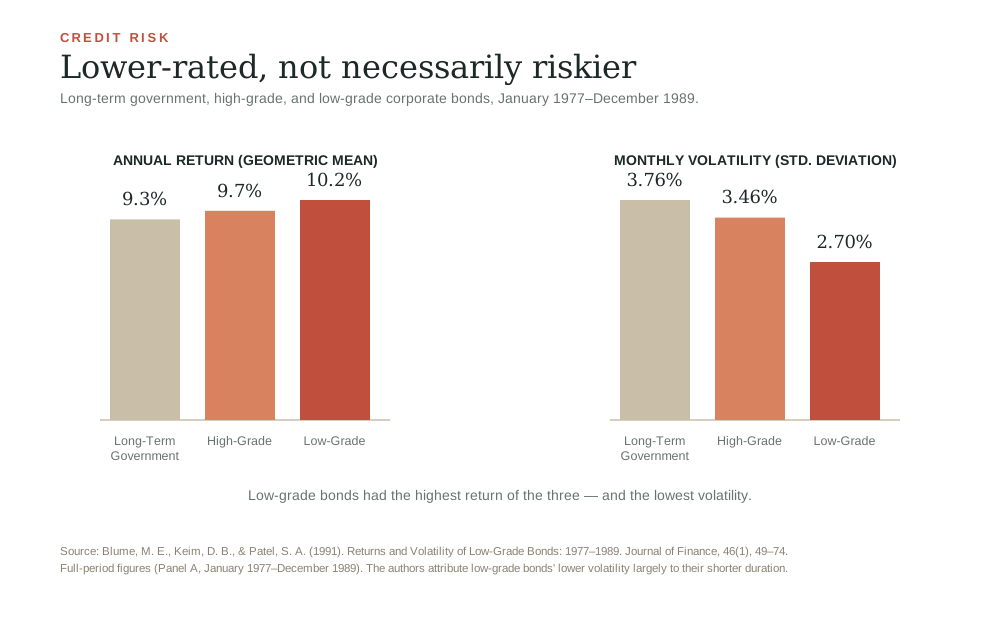
Because bond funds can be more diversified, an investor can not only buy AAA-rated bonds, as one would have to do with individual bonds, but also lower-rated bonds. Research on this exact question by Blume, Keim, and Patel, published in the Journal of Finance, found that low-grade bonds realized higher returns than higher-grade corporates over their sample period, with volatility that was actually lower than that of high-grade corporates or long-term government bonds.[^3] The explanation is structural rather than a market inefficiency: low-grade bonds tend to carry shorter duration, making them less sensitive to interest-rate swings, which offsets their added credit risk in the overall risk math. In other words, adding some lower-rated bonds to a diversified fund doesn't necessarily mean taking on proportionally more risk to chase that extra return.
Funds also offer accessibility: you can often buy in with as little as $1, thanks to fractional shares.
Bond funds and ETFs also benefit from lower transaction costs, because they're run by institutions trading in large blocks rather than the small, one-off trades individual investors make. Using a complete record of U.S. over-the-counter secondary trades in corporate bonds, researchers Edwards, Harris, and Piwowar found that average transaction costs decrease significantly as trade size increases.[^4] Goldstein, Hotchkiss, and Sirri found a similar pattern using actual trade data: median trading costs ran $2.13 per $100 of face value for trades of 10 bonds or fewer, versus just $0.34 per $100 for trades over 1,000 bonds.[^5]
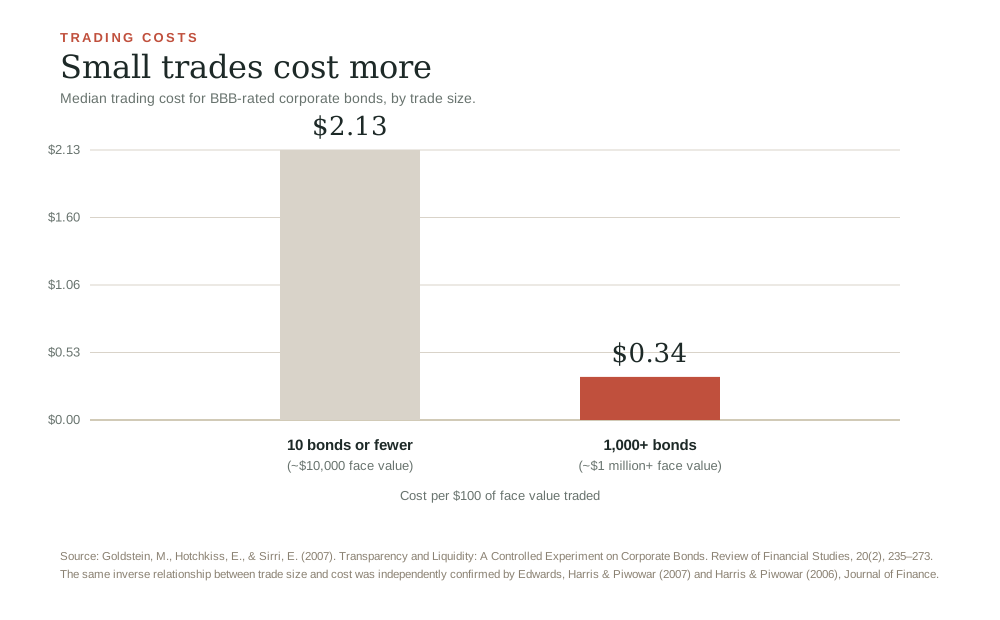
A similar pattern shows up in the municipal bond market, where the inverse relationship between trade size and spread has generally been attributed to differences in information available to retail versus institutional traders.[^6]
This scale advantage extends into higher liquidity as well. Using transaction-level data spanning 2003 to 2007, researchers Bao, Pan, and Wang found illiquidity in corporate bonds to be significant, substantially greater than what could be explained by simple bid-ask bounce.[^7] A bond fund or ETF share, by contrast, can typically be bought or sold in seconds on an exchange, without needing to find a specific counterparty for that specific bond.
Finally, bond funds offer a smaller but real benefit: time savings. Bond funds are easier to purchase, and distributions can be automatically reinvested into the fund at any dollar amount, as fractional shares.
On the flip side, bond funds don't have a defined maturity date. With the exception of some bullet bond funds, a fund's duration stays roughly constant over time rather than trending toward zero.
From Theory to Practice
The choice between using individual bonds, bond funds, or a combination ultimately comes down to your goals.
When Individual Bonds are the better choice:
- You have a known future liability and want price certainty about what you'll receive and when, tuition due in six years, for example.
- You want to build a bond ladder, so a portion of your fixed income matures on a schedule you control.
- You want full control over exactly which issuers, maturities, and credit qualities you hold.
When Bond Funds are the better choice:
- You want fixed-income exposure without building and maintaining a diversified portfolio yourself.
- You don't have a single, fixed date you need the money back by.
- You're investing smaller amounts and want fractional-share access, rather than needing $1,000 or more per bond.