Most stocks fail to beat Treasury bills. Over their lifetimes, only 42.6% of U.S. stocks have outperformed one-month T-bills, and a tiny fraction of companies account for essentially all of the market's net wealth creation. That's a problem for anyone who holds a handful of individual stocks, because the market's strong long-term return depends on a few extreme winners that a concentrated portfolio will probably miss.
This post looks at three pieces of evidence for why holding a concentrated portfolio of individual stocks is riskier than it looks: how skewed stock returns are, how rarely stocks beat the risk-free rate, and how often they suffer losses they never recover from.
Stock Skewness
Individual stocks have an asymmetric return profile. The maximum possible loss is -100%, while the potential gain is theoretically unlimited. This creates a right-skewed distribution of stock returns, where a relatively small number of extreme winners can contribute a disproportionate share of the market's total return. As a result, the market's average return can be significantly higher than the return earned by a randomly selected stock.
This skew is a natural consequence of compounding. Returns multiply rather than add, so a loss is capped at 100% while a gain has no ceiling. A stock that doubles, then doubles again, can grow to many multiples of its original price, but no stock can fall by more than everything it was worth. Over longer holding periods, this effect widens the gap between a few extraordinary outcomes and the many ordinary or poor ones, which means the typical stock's lifetime return can sit well below the average.
Heaton, Polson, and Witte[^1] illustrate this concept with a simple example. Imagine there are five stocks: one generates a 50% return, while the other four each generate a 10% return. An equal-weighted portfolio holding all five stocks would earn an average return of 18%. The challenge for an investor is that the 18% average return is being pulled upward by the single 50% winner. An investor who holds only a subset of the stocks therefore faces a meaningful risk of missing the winner and earning substantially less than the average.
Now imagine an investor selects either one or two stocks at random. There are 5 possible one-stock portfolios and 10 possible two-stock portfolios, for a total of 15 possible portfolios. Of the five one-stock portfolios, only one contains the 50% winner, while the other four earn 10%. Of the ten two-stock portfolios, six contain only 10% stocks and earn 10%, while four contain the 50% winner and earn 30%. Across all 15 possible portfolios, 10 earn 10%, four earn 30%, and one earns 50%, resulting in an average return of 18%, exactly matching the return of the equal-weighted portfolio.
Yet 10 of the 15 portfolios, or two-thirds, underperform the 18% average return. This illustrates an important distinction between average return and the probability of beating the average. Although the average return of the randomly selected portfolios equals the average return of the market, most individual portfolios underperform because the single extreme winner pulls the average upward. This is the fundamental challenge faced by an active investor: the investor must identify and own the relatively small number of stocks that ultimately generate a disproportionate share of market returns, while a broad index automatically owns them. The authors argue that this represents a potentially significant cost of active management beyond its explicit fees: the risk of underperforming by missing the market's extreme winners. The same logic applies to an investor's own stock selections.
This result connects to a core idea in financial theory. Markets compensate investors for bearing systematic risk, the kind that can't be diversified away. The risk specific to a single company, called idiosyncratic risk, such as a failed product, a lawsuit, or a new competitor, can be diversified away by owning many stocks, so there is no reason to expect extra return for bearing it. Skewness is what that looks like in practice: holding a handful of stocks exposes you to a wide range of outcomes, including a high chance of landing below the market's average, without any expected reward for the extra uncertainty.
Do Stocks Outperform Treasury Bills?
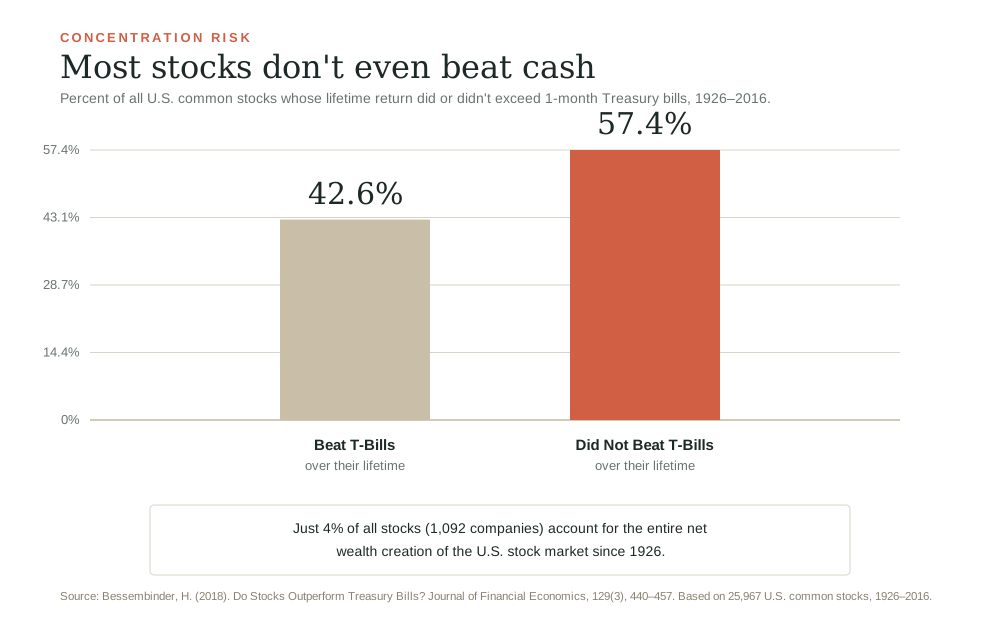
Given how skewed returns are, with a small number of stocks contributing most of the market's gains, it's worth asking what the returns of the rest of the market look like. Bessembinder[^2] found that only 42.6% of U.S. stocks beat one-month Treasury bills over their lifetime.
This is an important finding. Put another way, 57.4% of stocks failed to earn more than the risk-free rate. You could have taken far less risk and earned more.
Furthermore, just 4% of stocks, or 1,092 companies, account for all of the market's net wealth creation since 1926. The other 96% collectively just matched Treasury bills.
The top 86 stocks, roughly a third of one percent of all stocks, accounted for half of the approximately $32 trillion in net wealth created by the U.S. stock market since 1926, measured as the return earned above what Treasury bills would have produced.
The pattern isn't unique to the United States. Bessembinder, Chen, Choi, and Wei[^3] studied more than 64,000 stocks from around the world between 1990 and 2020 and found that wealth creation was just as concentrated. The top 2.4% of firms accounted for all of the roughly $75.7 trillion in net global stock market wealth creation, and outside the U.S., just 1.41% of firms accounted for the $30.7 trillion created. In that 1990 to 2020 sample, 55.2% of U.S. stocks and 57.4% of non-U.S. stocks underperformed one-month Treasury bills.
Many Stocks Suffer Permanent 70%+ Declines
We've established that 4% of stocks account for all of the market's net wealth creation and only 42.6% of stocks beat one-month Treasury bills over their lifetimes. A logical next question is: how poor has the performance been among the stocks that failed to outperform the risk-free rate?
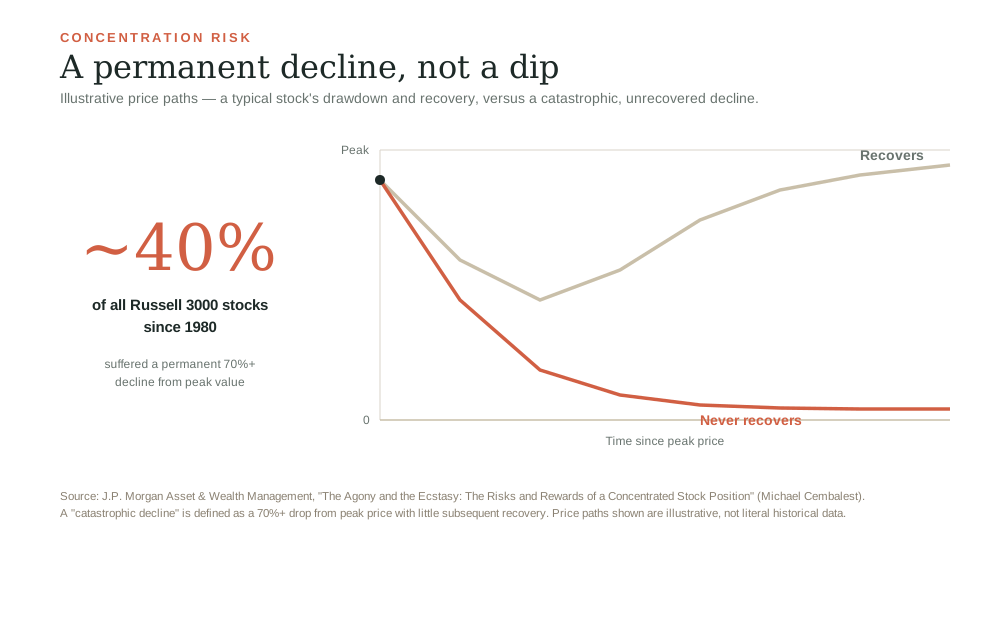
J.P. Morgan's The Agony & The Ecstasy report[^4] highlights the harsh reality of individual stock investing: a significant portion of stocks experience severe declines that are never recovered. Examining Russell 3000 stocks since 1980, they found that roughly 40% experienced a decline of at least 70% from their peak that was never recovered. J.P. Morgan defines these as "catastrophic" declines.
The risk was even more pronounced in certain industries. 57% of Information Technology companies experienced a catastrophic decline, while Biotech and Metals & Mining each had loss rates above 50%. J.P. Morgan attributes some of this to the process of creative destruction, where technological, economic, or competitive changes can cause once-successful companies to permanently lose their position.
They also found that the median stock underperformed the Russell 3000 by 54%, while approximately two-thirds of stocks underperformed the index.
A fair question is whether an index fund suffers from these same collapses, since it holds the same stocks. It does, but the damage is limited. No single company makes up more than a small slice of a broad index, so even a stock that falls 70% or more costs the index investor only a sliver of the portfolio. A concentrated investor who put a large share of their wealth into that stock absorbs most of the loss. The index also owns the rare extreme winners, so their gains offset the losses from the companies that fail, without anyone needing to predict which is which.
Why Investors Still Hold Concentrated Positions
There are many reasons investors continue to buy and hold individual stocks. From a behavioral perspective, familiarity bias can lead investors to favor companies they know well, including their employer or businesses they interact with regularly. Overconfidence can also cause investors to overestimate their ability to identify future winners.
There are also practical reasons for holding concentrated positions. Investors may have accumulated substantial unrealized gains in a stock and hesitate to sell because doing so would trigger a significant tax liability. Others receive equity compensation through stock options, restricted stock, or company shares, which can create concentrated positions even without an intentional decision to invest heavily in a single company. For business owners and controlling shareholders, a large ownership stake may also be necessary to maintain voting control.
If You Already Hold a Concentrated Position
If you're already holding a large single-stock position, the answer isn't necessarily to sell everything today, especially when taxes are involved. Investors commonly consider a few approaches: selling gradually over several years to spread out the tax bill, donating appreciated shares to charity, directing new contributions to diversified funds so the position shrinks as a share of the portfolio, or using tools like direct indexing or exchange funds, which each come with their own costs and eligibility requirements. If your position comes from equity compensation, the tax treatment of options and restricted stock varies, so it's worth understanding the rules before acting.
What to Do Instead
The evidence points in a consistent direction. A small number of extreme winners drive the market's returns, most individual stocks fail to beat Treasury bills over their lifetimes, and a large share suffer permanent losses. An investor holding a few stocks is betting on finding those rare winners in advance, and the most likely outcome of that bet is falling short of the market's average return.
A broadly diversified, low-cost, market-weighted index fund avoids the problem. It owns the whole market, including the rare stocks that create nearly all the wealth, without requiring you to identify them ahead of time, and it limits the damage from the companies that fail. Instead of trying to outguess the market, let diversification do the work for you. You're diversifying away idiosyncratic risk, which isn't rewarded, while keeping the systematic risk that is.